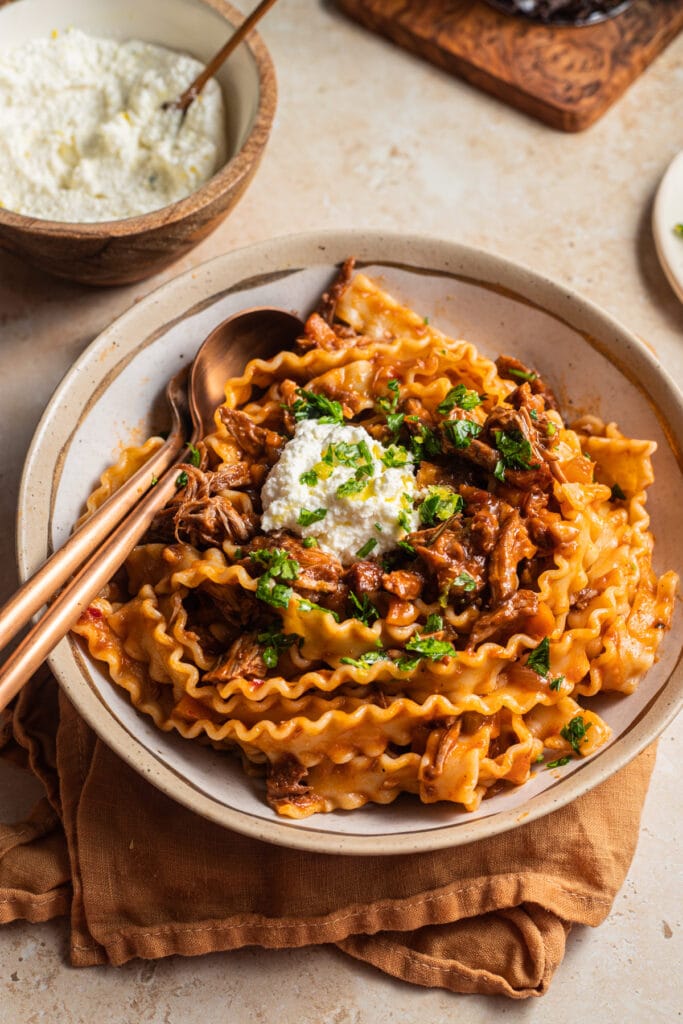
This slow-cooked lamb ragu delivers incredible depth of flavor, with tender bits of lamb gently simmered in tomato, red wine, and fragrant herbs until meltingly soft. It’s a show-stopping recipe, fit for a Sunday supper or date night. Serve with delicate ribbons of pasta (instructions included!), or enjoy with my mascarpone polenta or some crusty bread!

I first fell in love with saucy, meaty ragu when visiting Florence, Italy. There, I enjoyed many delicious dishes, from ribollita to Italian tiramisu to cold fermented pizza dough. The most memorable dish, though, was pici al cinghiale, or homemade pici pasta with Tuscan boar ragu.
The sauce was thick, robust, and meaty, with a subtle earthiness from a sprig of rosemary. From then on, I vowed to create a ragu with just as complex a flavor, and while boar is not easily accessible around here, lamb indeed is. After several tests, I’m excited to share this delicious lamb ragu sauce with you!
A Rich, Savory, and Luxurious Ragu
why you’ll love this recipe
- It’s so good. The savory notes of pancetta beautifully complement the tender, melt-in-your-mouth lamb shoulder, the tangy-sweet tomato sauce, and a subtle hint of spicy Calabrian chilies.
- It’s well-tested. Ragus aren’t an everyday affair, and if you’re going the extra mile to procure top-quality meat and dedicate a couple of hours to the kitchen, you’ll want it to be worth every minute. Rest assured, I’ve painstakingly perfected this dish to ensure it’s incredibly delicious and restaurant-worthy!
For more comforting stews, try my mushroom ragu, mushroom bourguignon, or shrimp cacciatore.
Ingredient Notes

- Boneless Lamb Shoulder: Compared to a leg of lamb, lamb shoulder has a higher fat content, yielding a juicier texture. You’ll want to trim off any excess fat, especially the thicker fat cap, but you can ask your butcher for help with this as well!
- Calabrian Chili Paste: Calabrian chili paste offers a fruity, spicy heat, but ½ teaspoon red pepper flakes can also be used in a pinch. I like to use the paste in all sorts of Italian recipes, from my spicy Calabrian chili pasta to spicy vodka rigatoni.
- Red Wine: Make sure to go with a dry red wine, like a Merlot, Malbec, or Pinot Noir.
- Tomato Passata: Tomato passata, or tomato purée, forms the base of the sauce. Mutti is my go-to brand. Feel free to use my homemade pomodoro sauce when tomatoes are aplenty!
For a full list of ingredients and quantities, refer to the recipe card.
How to Make This Recipe

Step 1 – Crisp the pancetta: To a large dutch oven, add the olive oil and pancetta, and cook, stirring occasionally, until lightly browned and crispy. Using a slotted spoon, transfer to a paper towel lined plate (Image 1).
Step 2 – Sear the lamb: Increase the flame to medium-high heat, and add the lamb in a single, even layer. Sear until *very* nicely browned (Image 2), then sear on the other side. Remove the from the pan onto a plate and set aside.
Step 3 – Cook the aromatics: Saute the onions, carrots, celery, and garlic until softened. (Image 3).
Step 4 – Deglaze with wine: Add the Calabrian chili paste, tomato paste, and rosemary. Saute for a couple of minutes until the tomato paste caramelizes nicely. Deglaze with a splash of red wine, scraping up the browned bits on the bottom of the pan with a wooden spoon (Image 4).

Step 5 – Add the liquids and meat: Add the browned lamb with its juices, the pancetta, passata, water, a pinch of salt, and brown sugar (Image 5), and bring to a boil.
Step 6 – Stew: Cover and simmer for 1 hour at a gentle, constant bubble over low heat. Uncover and simmer for about an hour until the meat is tender (Image 6).
Step 7 – Shred the meat: Allow the sauce to cool slightly, then shred the meat with two forks or your hands (Image 7). Discard the rosemary sprig.
Step 8 – Serve: If serving with pasta, I recommend bringing a large pot of salted water to a boil while the sauce is cooling. Cook pasta until al dente, then toss in the ragu with a bit of pasta water until it clings nicely to the sauce (Image 8). Serve hot, and enjoy!
Expert Tips
- To achieve that “all-day-slow-cooked-flavor”, resist the urge to constantly stir the pot. Allowing the ingredients to brown and caramelize is essential for the Maillard reaction, which builds a complex flavor profile.
- Constantly turning the lamb or stirring the tomato paste prevents this crucial process, and this is the number one mistake I’ve noticed in my cooking workshops with home cooks.
- Instead, step away for a few minutes and let the ingredients work their magic. This simple act of patience allows some of the best flavors to develop naturally, ensuring your dish reaches its full potential.
Recipe FAQs

I like to cover the pot for the first hour, so that the lamb has time to tenderize and soften without drying out. I finish by simmering uncovered to help reduce the sauce.
When simmering uncovered, ensure the meat is nicely coated in the sauce to prevent it from drying out. If you find the meat is drying out, or the sauce is reducing too quickly, you can cover the pot again.
Leftover ragu can be stored in an airtight container for 3 – 4 days in the fridge. The flavors will continue to develop over the next day, so you can easily make it a day in advance and reheat it just before serving.
Use your favorite pasta of choice here! I personally love using a longer pasta shape, like mafaldine or pappardelle pasta, but if you’re up for a project, you could go with a homemade orecchiette or ricotta gnocchi as well.
Did you try this recipe?
I would love to hear your feedback! Be sure to rate the recipe and leave a comment below.

Slow-Braised Lamb Ragu
Ingredients
For the ragu:
- 2 tablespoons extra-virgin olive oil
- 4 ounces thick-cut pancetta, diced into ½-inch cubes
- 1 ½ pounds lamb shoulder, trimmed of excess fat (especially the fat cap), yielding about 18 ounces | cut into 2 or 3-inch pieces
- Salt and black pepper
- 1 medium onion, finely diced
- 1 medium carrot, finely diced
- 1 stalk celery, finely diced
- 6 cloves garlic, finely minced
- 1 ½ teaspoons Calabrian chili paste, or ½ teaspoon red pepper flakes
- 2 tablespoons tomato paste
- 2 sprigs fresh rosemary
- 1 cup dry red wine
- 1 cup tomato passata, freshly pureed or store-bought
- 1 cup water
- 2 teaspoons brown sugar
For lamb ragu pasta (optional):
- 12 ounces dried pasta, such as pappardelle, mafaldine, or cavatelli (or 16 ounces fresh pasta)
- ½ cup whole-milk ricotta cheese, homemade or store-bought
- Zest from 1 lemon
- Salt and black pepper
- ¼ cup finely minced parsley
Instructions
For the lamb ragu:
- Crisp the pancetta: To a large Dutch oven or heavy-bottomed pot, add 2 tablespoons extra-virgin olive oil. Set over medium heat, and saute 4 ounces thick-cut pancetta for 4 – 5 minutes until crispy. Remove from the heat, and transfer pancetta to a paper towel lined plate. Set aside.
- Sear the lamb: Season 1 ½ pounds lamb shoulder pieces with a generous pinch of salt and black pepper on all sides. Increase the heat to medium-high, and arrange meat in a single layer. Sear on the first side until nicely browned, about 5 – 6 minutes. Flip and sear the other side until browned, about 3 minutes. Remove the lamb from the pan and transfer to a plate. Note: You may need to do this in 2 batches. Do not overcrowd, which can prevent proper searing.
- Cook aromatics: In the same pan, saute 1 medium onion (finely diced), 1 medium carrot (finely diced), 1 stalk celery (finely diced), and 6 cloves garlic (finely minced) until soft and lightly browned, about 8 – 10 minutes, over medium heat. Season with a pinch of salt and pepper.Note: Reduce the heat if the aromatics are browning too quickly, or add a splash of water to help deglaze the pan.
- Add the pastes: Stir in 1 ½ teaspoons Calabrian chili paste, 2 tablespoons tomato paste, and 2 sprigs fresh rosemary. Saute for an additional 3 – 4 minutes until the paste caramelizes, transforming from bright red to brick red, and begins sticking to the sides of the pan.
- Deglaze: Increase the heat to medium-high and add 1 cup dry red wine. Use a wooden spoon to scrape any bits of fond stuck to the bottom of the pan. Cook for 3 – 4 minutes until the liquid has reduced by half and the alcohol smell dissipates.
- Simmer: Stir in the reserved lamb, pancetta, 1 cup tomato passata, 1 cup water, a pinch of salt, and 2 teaspoons brown sugar. Bring the mixture to a boil, then reduce the heat and simmer, covered, at a gentle, constant bubble for 1 hour. Uncover and simmer for an additional 45 minutes – 1 hour and 15 minutes until the lamb is completely tender. Stir occasionally, scraping any bits from the bottom of the pot.Note: Stir occasionally to keep the lamb mostly submerged and prevent drying.
- Shred the meat: Cool slightly, then remove and discard the herb sprigs. Shred the lamb with a fork or your hands, return it to the sauce, and stir to combine. Season once more with additional salt and pepper as needed.
- Serve: Top with ¼ cup finely minced parsley and serve hot, alongside crusty bread, polenta, or pasta (recipe below).
For the lamb ragu pasta (optional):
- Cook the pasta: Bring a large pot of salted water to a boil. Add 12 ounces dried pasta, and cook until just before al dente. Drain and reserve 1 cup pasta water.
- Make the lemony ricotta: In a small bowl, combine ½ cup whole-milk ricotta cheese and Zest from 1 lemon, and season with salt and pepper. Set aside.
- Finish cooking: Transfer the pasta to the ragu and toss to combine. Cook over medium-low heat for about 1 – 2 minutes, until the sauce clings to the pasta, adding any pasta water as necessary to loosen the sauce.Divide amongst serving bowls, top with a dollop of ricotta and a garnish of parsley, and enjoy!
Notes
- Lamb: For a juicier texture, look for boneless lamb shoulder. Trim off any excess areas of fat, especially the fat cap; when in doubt, ask your butcher for help.
- Tomato Passata: Look for high-quality store-bought passata (or tomato puree), such as Mutti or Pomi, or make your own by pureeing fresh tomatoes until smooth.
- To achieve that quintessential rich slow-cooked flavor, avoid constant stirring. Let your meat brown, let the tomato paste caramelize, and allow the ragu to reduce.
Nutrition
The nutritional information on this website is only an estimate and is provided for convenience and as a courtesy only. The accuracy of the nutritional information for any recipe on this site is not guaranteed.