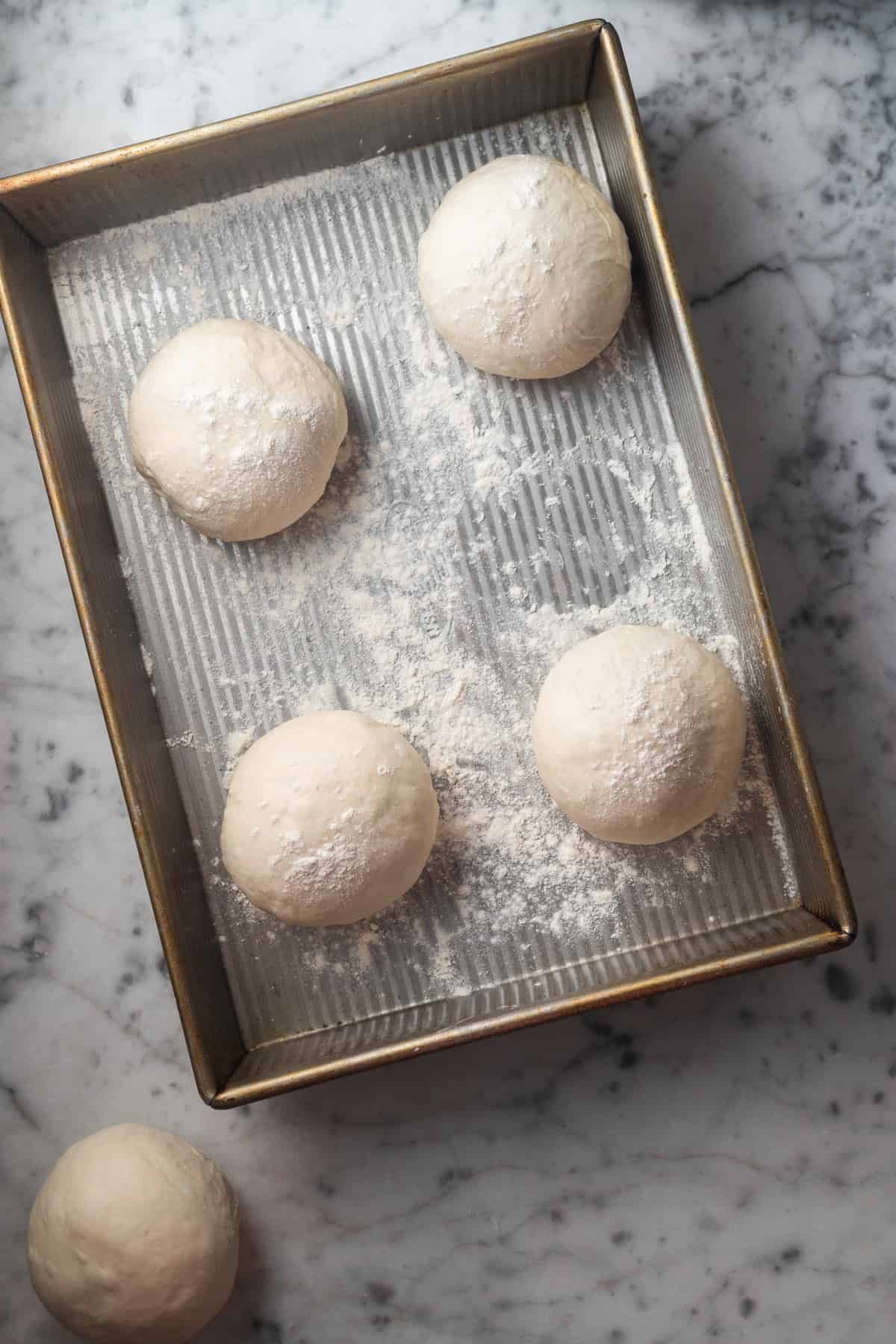
If you’re in the baking world, you’ve likely been told that long fermentation times are the key to great pizza. But why? In this article focused on the science of cold fermentation, I’ll walk you through what’s happening at a technical level, from temperature to time, to help you develop a delicious pizza crust.

Cold fermentation with a small amount of yeast is preferable to a fast, room-temperature fermentation with a large amount of yeast, as the slower, cooler process allows the dough to develop complex, rich flavors and a chewier, more extensible texture.
The extended fermentation allows enzymes to break down starches and proteins gradually, creating better browning and a lighter, airier crumb. In contrast, a warm, rapid fermentation with abundant yeast accelerates this process, producing more gas but fewer flavorful byproducts, often resulting in a dough that tastes bland and can be harder to stretch without tearing. Let’s dig in!
Journey to a Better Home Pizza
A few crucial factors can transform your homemade pizza from good to great. Proper technique is critical, from kneading to stretching to baking. The dough is equally important, including the ingredients used and their ratios. Finally, there’s a lot of science and experimentation in making great pizza dough.
But don’t worry. I’ve conducted extensive research for you and laid it out throughout the post below. The ultimate goal of this article is to provide you with the tips, techniques, and fundamentals you need to make an awesome pizza at home.
There’s a lot of valuable information here, and I’ve tried to make it as exciting and digestible as possible. Feel free to bookmark this page and come back to it as a reference. Once you’re ready, try my cold-fermented pizza dough or even my focaccia recipe!
What is Fermentation?
Let’s start at the beginning. Fermentation is a metabolic process that chemically breaks down a substance using bacteria, yeast, or other microorganisms.
For example, in pizza dough, yeast breaks down the sugars from the flour, which facilitates the dough’s rise in the oven. Additionally, when feeding on sugars, yeast produces carbon dioxide, which develops air bubbles and helps maintain the structure.
The Role of Temperature
Temperature is hugely significant throughout the whole life cycle of pizza dough.
Before Baking
All yeast-based pizza dough undergoes some level of fermentation. In the case of cold fermentation, the fermentation occurs in, well, colder temperatures (usually the fridge). At a cooler temperature, this happens much more slowly.
From research and analysis from other pizza professionals and myself, I’ve determined that fermentation at cooler temperatures yields better structure, texture, and flavor.
Interestingly, I read in a pizza forum once that the most optimal temperature for the dough is actually around 50°F (10°C) to 60°F (16°C).
Why? Well, at this temperature, the yeast is still active enough to do its thing (just at a slower rate than room temperature). Some avid home cooks will actually ferment their dough in a wine cooler!
But, rest assured, since most of you likely don’t have a wine cooler at home (myself included), a fridge works well too, it just takes a bit more time.
During Baking
Temperature also plays an important role in the baking phase.
At a higher temperature, pizza takes less time to cook through. For example, my Ooni pizza oven cooks a pizza in 90 seconds at 932°F (500°C), while my home oven takes 3 – 4 minutes at 550°F (288°C).
Higher temperatures result in more exterior charring with smaller charred spots, especially leopard spotting. As an extreme example, you would never see charred spots on a pizza cooked at 200°F (93°C), while a 932°F oven is hot enough to cause charring within a minute.
The longer a pizza takes to cook, the more it “dries out.” Because pizza takes less time to cook at a higher temperature, the pizza dries out less, yielding a softer crust with a doughier inside.
Below, I’ve compiled a few pizzas from over the years. The left-hand side shows pizzas baked in a standard oven, while the right-hand side demonstrates pizzas cooked at a higher temperature in my Ooni pizza oven.

With the help of my broiler, the pizzas on the left-hand side show some nice charring, but they are nowhere near as soft as the pizzas cooked in the Ooni.
As I said above, the Ooni pizzas take significantly less time to cook, so they’re softer but still have a considerable amount of charring because of the higher temperature. Neither of these is worse or better, just different, as we will see below.
Summary
Pizza cooked in a pizza oven or wood-fired oven usually has plenty of charring, often with smaller charred spots and a softer, doughier interior.
If you’ve ever had Neapolitan pizza, you might know it’s usually eaten with a fork and knife because the interior is quite soft and wet. If you put a boatload of toppings on your dough and baked it Neapolitan-style, they would weigh it down, maybe even enough to tear the crust. And at a shorter baking time, the interior toppings don’t cook as much. As a result, the sauce stays saucy, the mozzarella melts without crisping up, and the basil won’t char.
On the other hand, pizza baked at a lower temperature, say 500°F (260°C) to 600°F (316°C), requires a longer time to cook through and achieve browning. A NY-style pizza is an example of this; it has a sturdier crust, does not require a fork and knife, and can hold plenty more toppings.
Conclusion: Temperature, both in fermenting the dough and baking the dough, plays a huge role in the resulting crust.
The Importance of Time
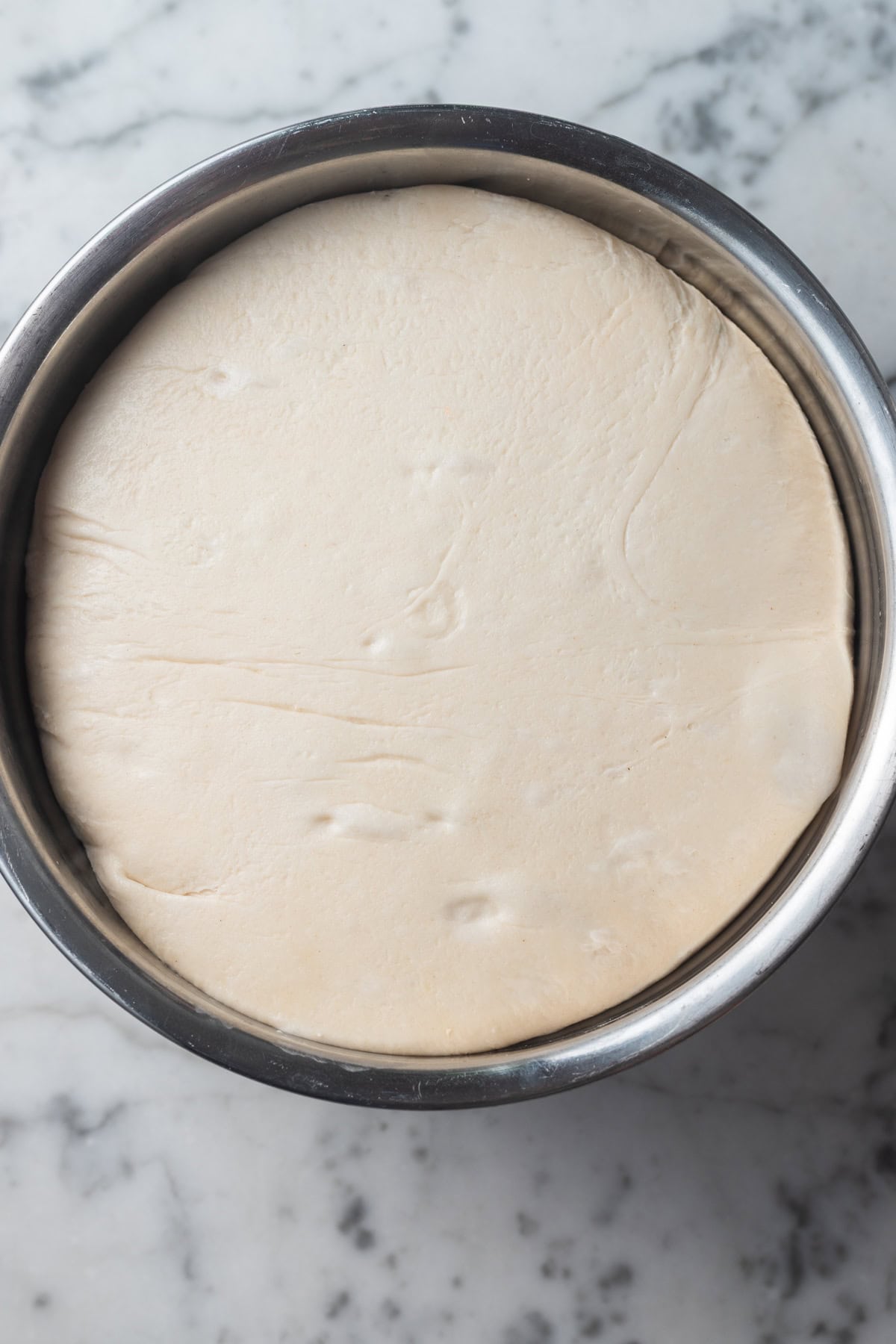
You’ve heard me say this several times now. Colder temperatures = slower fermentation = more complex flavors and better structure.
But how much slower is this fermentation? How long are you supposed to keep the dough in the fridge? And what exactly is the relationship between temperature and time when it comes to bread?
This is where yeast comes back into the picture. The more yeast you put into your dough, the faster the fermentation process occurs (more yeast leads to more carbon dioxide leading to more air bubbles).
Why Wouldn’t I Want to Speed Up Fermentation?
It’s a great question. I’ve told you that a slower fermentation at a colder temperature yields a better pizza…but what does that really mean? Why wouldn’t you just speed things up? It would be a lot easier.
I don’t disagree with you. Unfortunately, a speedier process doesn’t mean a better result. For example, you could put in more yeast and let your dough rise at room temperature for a couple of hours until it doubles in size. Then it would be very quickly ready to ball and bake. Let’s review the potential differences:
| Dough Type | Speedier fermentation at room temp | Slower, cold fermentation |
|---|---|---|
| Total Time | 1 ½ hours to 24 hours | 24 hours to 72 hours |
| Fermentation Temp | 72°F (22°C) | 40°F (4°C) |
| Yeast | Recipes typically call for more yeast | Recipes typically call for less yeast given a longer period of fermentation |
| Structure | Paler, tougher crusts and less bubbling | Typically better browning, improved structure, more bubbling and softer, chewier crusts |
| Flavor | Less complex, sometimes unpleasantly “yeastier” flavor | More complex, “aged” flavor |
Keep in mind that different recipes might yield different outcomes, but these are the results I’ve seen, from research online and my own experimentation.

Benefits of Cold Fermentation
Let’s summarize what we’ve learned so far. Slow, cold fermentation leads to better browning, improved structure, and bubblier, softer, and chewier crusts with more complex flavor.
On top of that, cold fermentation, when done properly, makes the dough easier to work with and stretch…meaning more circular pizzas and minimal tearing.
Finally, there is much more flexibility in timing. 24 hours is the minimum I like to keep my dough in the fridge, but the crust gets better and better up to 72 hours.
That leaves a 2 day window in which you can use the dough at any point. With a faster, room temperature dough, there is less room for error. If a recipe has you proof the dough for 2 hours, it might be over-proofed if you accidentally leave it out for an extra hour.
Ingredient Ratios
Water: Salt Ratio
The higher the ratio of water to flour, the more difficult (and stickier) the dough will be to handle. In the case of a Sicilian style thick-crust pizza, it’s more similar to a focaccia-like process where you’re not really hand stretching and tossing the dough so it matters less that it’s sticky.
A Neapolitan dough, however, requires a lot of technique to stretch properly, so a stickier product will be a big pain. And as you might expect, there is a balance here. You want enough water to create steam in the oven so that the pizza puffs up nicely and the crust doesn’t dry out too much without it being too sticky.
There’s also a peak absorption rate for each type of flour brand. Bakerpedia defines peak water absorption as “the water taken up by flour to achieve the desired consistency and create a quality end-product. It is the optimal amount of water you can add to a dough before it becomes too sticky to process.”
King Arthur bread flour, for example, has an estimated 62% absorption rate while Caputo 00 flours have a lower rate at 55% to 57%. In my recipe, I use a 62% ratio of water to flour to accommodate both types of flours, and I haven’t noticed too much stickiness with the Caputo flours at that level.
For more details on flours, check out my guide comparing Bread Flour vs. All-Purpose Flour vs. 00 Flour for Pizza.
Salt: Flour
Salt is another critical ingredient in pizzamaking. It plays many roles, from strengthening gluten to creating better elasticity and lowering stickiness. And there’s the obvious one: providing flavor!
Salt also slows down fermentation, which is super important as we mentioned in helping develop flavor. Typically, salt % in doughs range from 2% to 3%; I lean towards 2.5% to 3%, but if you prefer less salt, you could definitely get away with just 2.5%. Keep in mind, that decrease in salt might speed up fermentation slightly.
You might also like:


References
- Slow Rise Pizza
- The Perfect Loaf – Sourdough Pizza
- Baking Steel – 72 Hour Pizza Dough
- NYTimes – Roberta’s Pizza Dough & Video
- Cooks Illustrated – The Ultimate Pizza Set-Up
- Stadler Made – Pizza Calculator
- King Arthur – Using the Autolyse Method
- Bakerpedia – Water Absorption
- Pizza Making Forums – King Arthur Flour Absorption Rates
- Spruce Eats – The Science of Kneading Dough
- Serious Eats – All About Dry Yeast
- King Arthur Baking – Active Dry Yeast
- The Pizza Heaven – Salt in Neapolitan Pizza Dough