

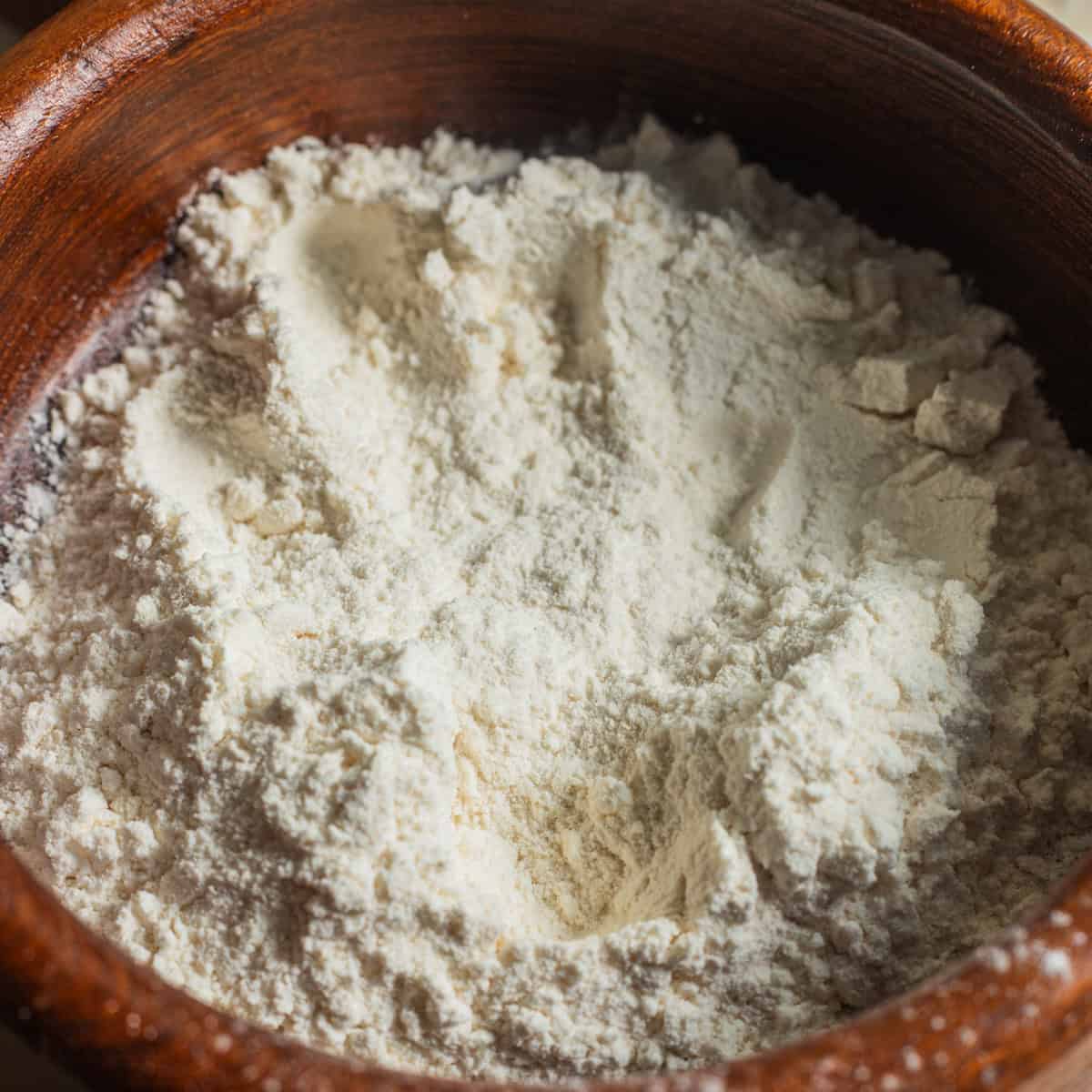
A quick and comprehensive summary of the differences between bread flour vs. all-purpose flour vs. 00 flour for pizza making. The good news? You can get away with using any of these for most home pizza making. Read on below to find out why.

Whether you’re a first-time pizza maker or a seasoned dough-slinger, one question might linger on your mind.
Does it truly matter what kind of flour you use when making pizza? And if so, why? How different is a standard all-purpose flour from bread flour? And what exactly is 00 flour? Well, you’ve come to the right place!
The Short Answer
Here’s a summary of the situation:
- In blind taste tests with average home cooks, flour preference came down to personal preference. Some people prefer a softer crust with less gluten formation; others prefer the opposite. For the average person, it doesn’t matter *that* much.
- Bread flour yields the most structure (because of a higher protein content) and works well for a Sicilian, Detroit, or NY-style dough.
- 00 flour yields less slightly structure with a softer, doughier texture and is easier to stretch, so it’s excellent for a NY-style/Neapolitan hybrid or Neapolitan dough.
- A high-protein (11.5%+) all-purpose blend won’t give you *perfect* results but will work pretty well as a substitute for most doughs.
Looking for a delicious pizza recipe? Try my cold-fermented pizza dough or Roberta’s pizza recipe!
Overview of Flours
We’ll get into more of the specific technical properties of each flour below, but for now, I’d like to give a quick overview of the general differences between the three.
- Bread Flour: Typically a flour with a higher protein content, bread flour is typically recommended for, well, breads!
- All-Purpose Flour: A more mid-range protein content suitable for a wide variety of applications.
- 00 Flour: The ’00’ here reflects the ash content, meaning the mineral residue left after the flour is burned at high temperatures, reflecting the wheat’s natural mineral content and degree of refinement. 00 flour is highly refined, so it’s very homogeneous with a finer texture.
Why it Matters: The Criteria
First, it’s important to remember that many different types of pizza exist. A NY-style slice has very different properties than a Neapolitan or Sicilian slice. As such, there are no “one-size-fits-all” criteria here.
That said, some characteristics span across different styles. Good pizza typically has a sturdy yet somewhat pliable crust with good gluten formation.
Here are some of the other criteria to consider:
- Protein Content: A high protein content leads to more gluten formation creating a better structure and a springier dough.
- Extensibility: Is the dough easy to work with? Does it stretch well without tearing? Is the resulting crust chewy without being tough?
- Hydration/Absorption Rate: Can the dough absorb water properly for a lower versus higher hydration dough without being too dry or sticky?
- Visual Appearance: Does the dough bake up differently at different temperatures? Visually, how does the crust look with these flours?
- Taste: Self-explanatory! Are there any significant differences in flavor?
We’ll discuss how each of these different flours vary according to these properties below.
Comparison

Protein Content
Protein Content: A high protein content leads to more gluten formation creating a better structure and a springier dough.
Now, let’s discuss the typical ranges for each type. For shortening purposes, KA = King Arthur Flour and AC = Antimo Caputo.
| Flour Type | Typical Protein Content | Examples |
| Bread | 12% to – 14% | KA Bread Flour – 12.7% |
| All-Purpose | 9% – 11.5% | KA All-Purpose Flour – 11.7% |
| 00 | 11% to 13.5% | AC Chef’s Flour – 13.5% AC “00” Pizzeria Flour – 12.5% KA “00” Pizza Flour – 11.5% |
While each category does vary quite a bit in terms of protein content, most all-purpose brands have the lowest amount of protein followed by 00 flour and then bread flour.
Now, it’s worth noting a couple of additional things. First, as we discussed above, the ’00’ noting really has nothing to do with protein content. However, most brands will have a higher amount as it’s typically sold for breads and pizzas.
Extensibility
Though it can be manipulated, extensibility is inversely correlated with protein content.
That is, the higher the protein content, the more gluten formation in the dough, and the more the dough “springs back” to hold its shape when stretched.
Why would that matter?
Well, in a Neapolitan dough, or even a NY-style crust, you really want to be able to stretch and shape the pizza into a thin circle. So, in this case, you actually don’t want *too* much extensibility. In a Sicilian style pizza, or a baguette, though, you want more extensibility.
Based on protein content, we can assume that bread flour results in the least extensibility, while AP flour results in the most.
Going back to our protein table, King Arthur flour is notable in that the AP variety has a decently high protein content. This makes it very usable for pizza. Their 00 “pizza” variety, though, actually has slightly less than the AP variety.
You can see a similar pattern with AC’s Chef’s blend versus their Pizzeria blend. This is likely to create an optimal level of extensibility while still having a good amount of structure.
Hydration/Absorption Rate
Is the flour able to absorb water properly for a lower versus higher-hydration dough without being too dry or too sticky?
| Type | Typical Hydration | Typical Absorption Rate | Examples |
| Bread Flour | 65% – 75% | 62% – 65% | KA Bread Flour – 62% +/- 2% |
| All-Purpose Flour | 60 – 70% | 60% – 62% | KA All-Purpose – 61% +/- 2% |
| 00 Flour | 55% – 65% | 55% – 60% | AC Chef’s Flour – 55% – 57% AC “00” Pizzeria Flour – 55% – 57% |
Based on the absorption and typical hydration, 00 flours can hold the least amount of water before getting too “sticky” while bread flours can hold the most.
Thus, a higher-hydration dough might be better with a bread flour than a 00 flour.
Visual Appearance
After testing various doughs with different flours, here are the general results that have been confirmed across various channels:
Bread Flour: Typically results in a chewier crust with more gluten formation, a higher rise, and more browning.
All-Purpose Flour: Leads to a lower rise with medium browning.
00 Flour: Typically a medium rise with less browning and a slightly more tender crust with some chew.
Taste
Funnily enough, when I tested these flours against one another in a blind pizza test, there was no unanimous winner. One person preferred the softer texture of the all-purpose blend, while another liked the structure of the bread flour.
Over the years, I’ve tested all of these flours across different styles of pizza and realized that a lot comes down to personal preference.
Pizzas baked at a lower temperature often benefit from something like bread flour, especially for a Sicilian-style or Detroit-style crust where you want nice browning and a lot of structure.
At a higher temperature, 00 yields a lighter, more tender crust with many nice charred spots reminiscent of a typical Neapolitan dough. Bread flour works well, too, but will give you a much larger, puffier rise with more structure.
The other benefit is that a 00 is also easier to work with, as we discussed when examining extensibility. It’s more likely to stretch into a thin shape without springing back or tearing.
With a Sicilian crust, you won’t need to worry about that so bread flour really does work better. These dough types also tend to have higher hydration, which is perfect for this type of flour.
And what about all-purpose? If you use a higher protein variety, like King Arthur’s, you can achieve a pretty good crust regardless of what type of dough you use.
That said, if you’re looking for a top-tier, traditional Neapolitan pizza, you’ll want to go for the 00.
FAQs

A lot! Honestly, flour brands vary considerably in protein content, absorption rate, etc. This is why I recommend specific brands for consistency purposes!
Pizza flours often have a higher protein content with a finer texture for a better crust. However, I do recommend taking a look at the bag and assessing the different properties to ensure it’s the right option for you!
Yes, it does. The ash content is the mineral residue left after the flour is burned at high temperatures, reflecting the wheat’s natural mineral content and degree of refinement. A higher ash content will have more textural variation, which can “cut” the gluten strands, resulting in a lower gluten content.
This is why whole wheat flour, with a higher content, often yields denser bread. 00 flour has an extremely fine and homogeneous texture on the other hand of the spectrum.
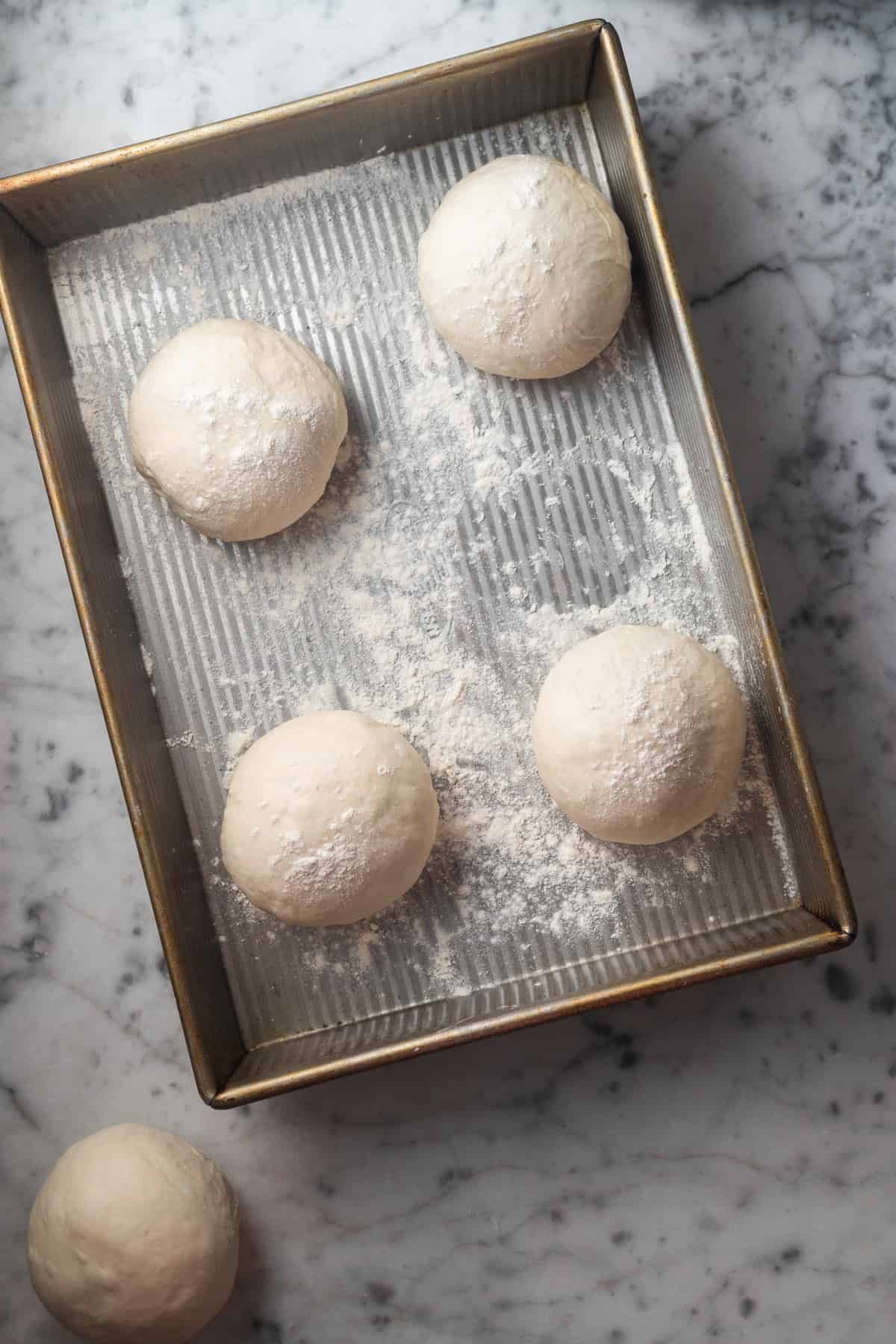



I am trying your 72 hour cold fermented pizza dough in dry Colorado. I am using bread flour instead of 00 flour. Should I add more water? The dough seems drier than the one in your photos and video.
Thanks in advance.
Hi Bianca,
Full disclosure, I’m not super familiar with higher altitude baking but I do think this recipe has a bit of flexibility; did you measure by weight? If so, I’d increase the water to 64% to 65% hydration, so 440g to 446g total water. Also, I’d wait to add more until after the initial autolyse stage as the texture can change as the dough hydrates in this phase. I hope that helps!