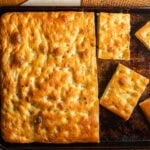
Samin Nosrat's Focaccia
A step-by-step blog post demonstrating how to make Samin Nosrat's focaccia recipe from Salt, Fat, Acid Heat, a Ligurian-style focaccia with a crispy exterior and soft inner crumb.
Servings: 16 servings
Calories: 186kcal
Equipment
- 1 Large Mixing Bowl at least 6 quarts
- 1 Medium Mixing Bowl
- 1 Large Baking Sheet 13 x 18-inches
Ingredients
For the dough:
- 5 ⅓ cups all-purpose flour not fluffed or leveled*
- 2 tablespoons Diamond Crystal Kosher salt or 1 tablespoon fine sea salt
- 2 ½ cups lukewarm water
- ½ teaspoon active dry yeast
- 1 tablespoon honey
- ¼ cup good-quality extra-virgin olive oil plus more for oiling the pan
- Flaky salt for finishing
For the brine:
- ⅓ cup lukewarm water
- 1 ½ teaspoons Diamond Crystal Kosher Salt
Instructions
- Mix dry ingredients: Whisk 5 ⅓ cups all-purpose flour and 2 tablespoons Diamond Crystal Kosher salt in a very large bowl.
- Mix wet ingredients: In a medium bowl, combine 2 ½ cups lukewarm water, ½ teaspoon active dry yeast, and 1 tablespoon honey. Note: If you're concerned if your yeast is alive, you can wait 5 - 10 minutes to see if the liquid shows any signs of activity; otherwise, proceed to the next step.
- Mix dough: Form a large well in the center of the flour, and pour in ¼ cup good-quality extra-virgin olive oil and the yeast mixture. Slowly begin incorporating some of the liquid into the flour, making sure to scrape down the sides of the bowl. Continue mixing until fully combined and dough is shaggy but no dry bits remain (it won't be super smooth at this point).
- Proof: Cover the bowl with plastic wrap, and let rise at room temperature for 12 - 14 hours, or until fully doubled in size. Note: I like to keep the dough in a relatively warm environment (around 70°F - 72°F). If your home is cooler or hotter, it can take more or less time.
- Stretch: The next day, oil a large baking sheet with 2 tablespoons of extra-virgin olive oil or as much needed to generously coat it.Gently transfer the dough to the baking sheet. Cover the top with a bit more oil, and stretch towards the edges of the pan, placing your fingers underneath the dough and gently stretching without tearing.Continue stretching the dough every 10 - 15 minutes or so for about 30 minutes until it mostly covers the edges of the pan. Note: At this point, it's normal for the dough to resist stretching. As it continues to relax, it will become easier.
- Make the brine: In a small bowl, whisk ⅓ cup lukewarm water and 1 ½ teaspoons Diamond Crystal Kosher Salt until the salt has fully dissolved. Pour liquid over the whole surface. Tilt the pan, carefully, to distribute the water evenly without spilling. Allow the dough to rise for another 45 minutes, or until the dough appears puffy and bubbly.
- Preheat the oven: 30 minutes before the dough is done proofing, arrange one rack in the center of the oven and one rack in the upper-third. Place a baking steel, baking stone, or large, sturdy baking sheet on the center rack. Preheat to 450°F / 232°C.Sprinkle the top of the dough all over with flaky salt.
- Bake: Bake on top of the baking steel (or stone or sheet) for 25 - 30 minutes, or until the bottom crust is nice and golden brown. Transfer to the upper rack, and bake for an additional 5 - 8 minutes until the top is nicely browned too. TIP: Use a sturdy metal spatula to lift the dough and check if the bottom is fully browned.
- Remove focaccia from the oven, and immediately brush the top with a couple tablespoons of olive oil. Cool for 5 minutes, then run the metal spatula around the edges of the pan to release the focaccia. Carefully transfer the bread to a cooling rack to cool completely (or at least until it's just barely warm, if you're impatient like me). Slice into individual pieces, serve, and enjoy!
Notes
- * The metric measurements in the original recipe list that 1 cup flour = 150g, which is the typical amount without fluffing, scooping, or leveling the flour. So don't feel the need to do that in this recipe if measuring in cups!
- If necessary, you can omit the flaky salt (but make sure to still season the top of the bread before baking!)
- Don't be shy with the oil: The oil in this recipe helps to impart a delicious flavor and develop a burnished crust. Make sure to use plenty of oil to coat the bottom of the pan, or it will be more likely to stick which can be quite messy to remove!
- Storage: Leftover focaccia should be cut into individual pieces and stored in an airtight container at room temperature for 2 - 3 days.
- Reheating: Day-old pieces taste best warm, so I recommend sprinkling them with just a touch of water, wrapping in foil, and reheating in the oven at 350°F/177°C for 5 - 10 minutes until warmed through.
- Freezing: You can also freeze them for longer-term storage. To do so, wrap each piece in plastic wrap, store in an airtight Ziploc bag, and freeze for 1 - 2 months. Reheat via the same method as outlined above, just make sure to remove the plastic wrap first!
Nutrition
Calories: 186kcal | Carbohydrates: 33g | Protein: 4g | Fat: 4g | Saturated Fat: 1g | Polyunsaturated Fat: 1g | Monounsaturated Fat: 3g | Sodium: 657mg | Potassium: 46mg | Fiber: 1g | Sugar: 1g | Vitamin A: 1IU | Vitamin C: 0.01mg | Calcium: 8mg | Iron: 2mg
