Pici Pasta Recipe
Pici are rustic, hand-rolled Tuscan pasta with the texture of thick spaghetti. Best of all? They require just a few ingredients and no special equipment!
Servings: 4 servings
Calories: 340kcal
Equipment
- Bench Scraper optional
- Spray Bottle for misting the dough as needed | optional
- Sharp Knife
Ingredients
- 320 grams 00 flour or another high-protein white bread flour (see notes below) | you can also use a mix of 00 flour and semolina flour for a firmer bite (notes below)
- 1 teaspoon Diamond Crystal Kosher Salt use half the amount if using any other type of salt
- 160 ml water plus more as needed
- 15 ml extra-virgin olive oil plus more as needed
- Semolina flour for coating and dusting
Instructions
- Form the well: In a large mixing bowl, combine 320 grams 00 flour and 1 teaspoon Diamond Crystal Kosher Salt. Using your fist or a small glass, form a well in the center of the flour. Pour 160 ml water and 15 ml extra-virgin olive oil into the well.
- Mix: Using a fork, begin incorporating some of the flour into the liquid, stirring to combine. Continue mixing more and more of the flour into the well, whisking until the liquid in the well starts thickening. Once it becomes thick and pasty, place the fork down. With your hands or a bench scraper, alternate between incorporating more of the remaining flour and kneading the dough in the bowl.
- Knead: Knead until everything comes together into a rough, shaggy mass, then transfer the dough to a wooden surface or countertop, about 2 - 3 minutes.Continue kneading, for about 5 - 8 minutes, until the dough feels soft, tacky (but not sticky or dry), and almost perfectly smooth. Note: The key here is ensuring the dough is soft, but not dry or sticky at all (If it's even barely sticky at this point, it'll only become stickier as it rests). As you continue kneading, the flour will continue to hydrate and come together into a smoother ball. If it still feels sticky after several minutes of kneading, add a teaspoon of flour at a time until it’s become more smooth and soft. Conversely, if the dough feels slightly dry (which can happen in drier climates), you can gently mist it or lightly wet your hands.
- Rest: Wrap the dough tightly in plastic wrap and allow it to rest at room temperature for one hour (up to 2 hours). This resting time will relax the gluten and smooth out the dough further.
- Prep the baking sheet: After resting, line two large baking sheets with parchment paper, and generously dust them with semolina flour. Place a small bowl of semolina next to the baking sheet and set aside.
- Roll: Cut off a quarter of the dough. Re-wrap the rest of the dough and set aside. On an unfloured wooden cutting board, roll out the quartered piece of dough to a rough rectangle shape about ⅛-inch (~5/16 cm) thick. If the dough begins to dry out, you can brush it with a bit of olive oil to help moisten it.Note: The dough may form more of an "ovular" rectangle, which is fine! Don't stress too much about this.
- Slice: Arrange the rectangle of dough so that the long way is facing you. Use a sharp knife (or a bench scraper) to cut the dough into ¼-inch (~⅝cm) wide strips. Note: I find the easiest way to cut the dough into clean strips is to firmly drag the knife from one end of the dough to the other (as opposed to slicing the dough).
- Shape: On an unfloured wooden cutting board or work surface, roll each strip until it forms a thick spaghetti-shaped strand. To roll the strips, place both hands at opposite ends of the dough and spread your fingers apart. Applying even pressure, begin moving your fingers over the strand in opposing, outward directions to thin out each piece to ⅛-inch (~5/16cm) to 3/16-inch (~½cm) thickness. Examine the strand and even out any uneven sections.This process can take a bit of practice to get the hang of things. If you're having difficulty, you can also pick up the strand in your hands and pinch the short ends together to create a rounded cylindrical-esque surface, then roll it with your hands to seal any gaps and thin out the strand. Note: An unfloured wooden surface is the easiest platform for rolling the pici. A countertop will also work, but it may create a bit of friction. If the dough feels resistant to roll (due to friction or dryness), you can moisten your hands slightly to help it move. For best results, keep your dough tightly wrapped in plastic wrap to prevent it from drying out.
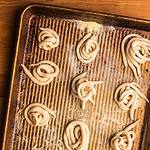
- Finish shaping: Finally, pick up each end of the strand in your hands and taper it to a rounded tip.Dip each strand into the semolina flour, then transfer it to the baking sheet. Make sure the noodles are not touching one another. Repeat the process with the remaining pieces of dough.
- Cook: To cook the pici, bring a large pot of salted water to a boil. Add the noodles, stirring to separate them. Boil for 2 - 4 minutes, or until they've cooked through but still retain a bite. Drain the noodles and serve with your favorite sauce.
Video
Notes
*Flour: For 00 flour, I recommend Antimo Caputo brand or Molino Grassi. Do not use King Arthur 00 flour (it yields a stickier dough). For a firmer texture and al dente bite, use 160g 00 flour and 160g semola rimacinata flour.
Tips:
- Roll the pici on a wooden surface free of flour to eliminate sources of friction.
- Keep the dough tightly wrapped at all times to prevent it from drying out.
- Don’t worry too much about perfectly even strands -- they're meant to be rustic! As long as they're relatively similar in thickness, they'll cook up fine.
Nutrition
Calories: 340kcal | Carbohydrates: 65g | Protein: 9g | Fat: 4g | Saturated Fat: 1g | Polyunsaturated Fat: 1g | Monounsaturated Fat: 3g | Sodium: 585mg | Potassium: 96mg | Fiber: 2g | Sugar: 0.2g | Calcium: 14mg | Iron: 4mg
