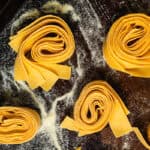
Homemade Pappardelle Pasta Recipe
A simple guide on how to make homemade hand-cut pappardelle pasta with step-by-step instructions and photos.
Servings: 4 servings
Calories: 420kcal
Equipment
- Bench Scraper or a Sharp Knife
Ingredients
1 batch pasta dough (recipe follows):
- 360 grams 00 flour
- 208 grams large eggs see notes for an egg yolk variation
- 2 teaspoons extra-virgin olive oil
- ⅛ teaspoon kosher salt
- Semolina flour for dusting
Instructions
Make the Dough:
- Form the well: To a large bowl, add 360 grams 00 flour. Using your fist, create a wide well in the center of the flour. Pour 208 grams large eggs, 2 teaspoons extra-virgin olive oil, and ⅛ teaspoon kosher salt into the well. Using a fork, whisk the eggs until homogenous.
- Knead: Slowly begin mixing some of the surrounding flour into the well. Begin incorporating more and more of the flour into the well, whisking with the fork until the liquid in the well starts thickening. Once it becomes thick and pasty, pour everything onto a clean work surface. Using a bench scraper (or a sharp knife), begin cutting the pasty bits into smaller pieces, then mixing them into the dry bits. Knead until it comes together into a shaggy mass. If it’s feeling quite dry (which can happen in the winter), you can wrap the dough in plastic wrap and allow it to rest for 15 minutes to hydrate better. If after 15 minutes the dough still feels dry, knead in a teaspoon of water at a time as needed.Once the dough has come together into a solid mass, wash and dry your hands. Discard any unincorporated dry bits from the work surface with a bench scraper.Knead aggressively, digging the heel of one hand into the dough and stretching it, then folding the dough over itself. Rotate 45 degrees and repeat digging, stretching, folding, and rotating for 5 - 7 minutes.
- Rest the dough: At this point, it should feel quite smooth and slightly tacky but not sticky — with no dry bits remaining.Wrap dough tightly in plastic wrap. Rest for at least 30 minutes (up to 2 hours) at room temperature before rolling out.
- Divide rested dough into 4 equal pieces. Roll out one piece at a time, leaving the rest in plastic wrap. Roll out a section of dough until it’s about ⅓-inch thick.
- Roll out the dough: Feed the dough through the widest setting twice. The dough will likely form an oval shape.To create a uniform rectangle, fold the top third of the dough down and the bottom third up, slightly overlapping, like a letter fold.Using a rolling pin, roll the dough out to ¼-inch thickness. Feed, once again, through the widest setting. It may not be a uniform rectangle yet, so if needed, you can fold it into the envelope shape once more and feed through the widest setting.Feed the dough through the next setting ('2') twice, then repeat this process at each subsequent setting, rolling twice per setting, until you reach your desired thinness. I recommend setting '5' for a Marcato Atlas and setting '6' for a Kitchenaid.
- Cut: Cut the sheet crosswise into 3 equal pieces to make shorter noodles. Generously dust with semolina flour to prevent sticking. Loosely fold the sheet of pasta over itself lengthwise (the long way) in 2 ½-inch increments.Use a sharp knife to cut widthwise (the short way) into ¾-inch to 1-inch pieces.
- Unfurl the pasta, then dust semolina flour to prevent sticking. Loosely twirl it into a nest and store on a semolina-dusted baking sheet covered with a kitchen towel. Repeat rolling out and cutting the remaining dough.
- Cook the pasta: Cook fresh pasta in a large pot of salted boiling water until al dente. Fresh pasta cooks very quickly, so it may be done in as little as 1 minute depending on the shape. Sauce and serve!
Notes
Egg Yolk Variation: Use 3 large eggs (~150g) and the remaining ~58g in egg yolks, about 3 large yolks. Use a scale for best results. For a more al dente texture, swap 25% of the 00 flour with semola rimacinata.
Trim the pasta sheets. I like to trim each pasta sheet for straighter edges.
Knead on a wooden cutting board. Wood absorbs moisture and prevents sticking or rapid drying. Non-wood surfaces will work but can yield slightly stickier dough.
Storage Instructions:
- Room Temperature: Arrange freshly cut pasta on a baking sheet dusted with semolina and let it rest for up to 2 hours. Cover with a damp kitchen towel if it begins to dry out.
- Refrigerator: Store fresh pasta in an airtight container in the fridge for up to 24 hours. Layer it with semolina-dusted parchment paper to prevent sticking.
- Freezer: For longer storage, spread the pasta in a single layer on a parchment-lined baking sheet and freeze for 1 hour. Then, transfer it to an airtight container or freezer bag and store for up to 1 month. Cook straight from frozen.
Nutrition
Calories: 420kcal | Carbohydrates: 69g | Protein: 16g | Fat: 8g | Saturated Fat: 2g | Polyunsaturated Fat: 2g | Monounsaturated Fat: 3g | Trans Fat: 0.02g | Cholesterol: 193mg | Sodium: 148mg | Potassium: 168mg | Fiber: 2g | Sugar: 0.4g | Vitamin A: 281IU | Calcium: 43mg | Iron: 5mg
