Homemade Orecchiette Recipe
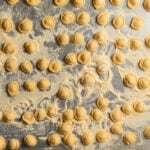
Homemade orecchiette pasta is a joy to make (and eat!), and my recipe will help you craft it from scratch, with just two ingredients: flour and water.
Servings: 4 servings
Calories: 288kcal
Equipment
Ingredients
- 320 g semola rimacinata flour or semolina flour | plus more for dusting
- 160 ml lukewarm water
Instructions
- Make the dough: To a large bowl, add 320 g semola rimacinata flour. Make a well in the center, and add 160 ml lukewarm water into the well. With your hands or a fork, slowly begin incorporating a little bit of flour into the water. As you continue incorporating flour, the water will transform from a loose liquid into a thick paste. Alternate between adding in the remaining flour and kneading until a shaggy dough forms. Use a bench scraper to gather any loose bits from the work surface and your hands.
- Knead and rest: Once the dough forms a solid mass, transfer it to a clean surface and begin kneading. Press the heel of your hand into the dough to stretch it, then rotate it 45 degrees counterclockwise. Continue kneading until the dough is soft and smooth, about 10 - 15 minutes. Wrap tightly in plastic wrap and let the dough rest for at least 1 hour at room temperature (up to 2 hours) before using.
- Roll: Lightly flour a baking sheet with semolina, and set aside. Cut off a piece of dough the width of two fingers, and put the remaining dough under an overturned bowl or wrap with plastic wrap, to keep it from drying out. Place your hands over the dough with your fingers spread. Using light pressure, roll the dough back and forth, moving your hands outward from the center to gently elongate it into a rope.On the work surface, roll the piece of dough into a rope ½-inch thick in diameter. Cut the rope into ½-inch pieces.
- Form the pasta: To form the orecchiette, take one piece of dough and place it cut-side up (have the rough side facing you). Using a serrated butter knife, position the blade slightly below the top edge of the dough, leaving a small border at the top. Press the serrated edge firmly into the dough and drag the knife toward you at a 45-degree angle. The dough will curl around the blade as you pull. Turn the curled piece inside out over your thumb, gently pressing around the edges to form a small ear shape. Transfer to the prepared baking sheet and repeat with the remaining dough.
- Cook: Bring a large pot of salted water to a boil. Add pasta, and cook for 1 - 2 minutes until the orecchiette float to the surface then boil for an additional 2 - 3 minutes until chewy and al dente. Transfer pasta with a slotted spoon to your sauce pot, coat in sauce, and serve.If cooking from frozen: Cook directly from frozen (do not thaw), adding 1 – 2 minutes to the cooking time above.
Video
Notes
Tips:
Storage:
- Although kneading for at least 10 minutes may seem tedious, it's crucial! Kneading develops the gluten in the pasta, resulting in a delightful chewy texture without any doughiness or undercooked taste.
- The dough needs to rest and relax for an hour so that it's easier to work with when forming the shapes. Otherwise, it tends to spring back!
- Firmly press the knife's serrated edge into the dough, as this action scrapes and creates a rough texture, essential for sauces to cling to.
- Short-term storage: Freshly made orecchiette can be stored at room temperature for 3 - 4 hours on a semolina-dusted baking sheet.
- For long-term storage, I recommend freezing. Generously dust a baking sheet with semolina flour, then arrange the pasta in an even layer. Freeze for 1 hour, then sift out excess flour and transfer pasta to Ziploc freezer bags. Seal and freeze for up to 2 months. Cook directly from frozen, but add 1 - 2 minutes to the cooking time.
Nutrition
Calories: 288kcal | Carbohydrates: 58g | Protein: 10g | Fat: 1g | Saturated Fat: 0.1g | Polyunsaturated Fat: 0.3g | Monounsaturated Fat: 0.1g | Sodium: 3mg | Potassium: 149mg | Fiber: 3g | Calcium: 15mg | Iron: 3mg
