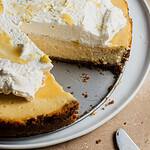
Lemon Gingersnap Cheesecake
My favorite winter cheesecake featuring a luxurious lemon filling and a gingersnap cookie crust.
Servings: 10 servings
Calories: 365kcal
Equipment
- 9-inch non-stick springform pan
- A large roasting tray or pan
- IR thermometer optional
Ingredients
Crust:
- 8 ounces gingersnap cookies
- 25 grams brown sugar
- 70 grams melted butter
Filling:
- 250 grams granulated white sugar
- 1 lemon zested and juiced
- 3 (8-ounce) packages Philadelphia cream cheese softened to room temperature
- 1 (4-ounce) container lemon skyr or lemon greek yogurt | or any citrus skyr or greek yogurt, such as lime or orange
- 2 teaspoons vanilla extract
- 1 teaspoon ground ginger or 1 tablespoon freshly grated ginger
- ½ teaspoon ground cinnamon
- ⅛ teaspoon kosher salt
- 4 large eggs room temperature | 228 grams with shell
Topping:
- 118 grams heavy cream
- 16 grams powdered sugar
- ½ cup lemon curd room temperature
- Zest from 1 lemon optional
Instructions
- Set one rack in the bottom-third of the oven and one in the middle of the oven. Preheat oven to 350°F/177°C.
- Prep the cheesecake pan: Grease the bottom and sides of a 9-inch springform pan with nonstick cooking spray. Cut out a 9-inch circular piece of parchment paper and line the bottom of the pan.
- Make the crust: In a food processor, pulse 8 ounces gingersnap cookies until they resemble the texture of coarse sand. Transfer cookie crumbs to a medium bowl and wipe the food processor clean.Note: You may have a few bigger pieces among the cookie crumbs. You can either discard them or just separately crush them up.
- Mix in 25 grams brown sugar and ¾ of the melted butter. The mixture should have the texture of wet sand. Once combined, take a portion of the mixture, pressing it between your fingers; if it sticks together, the crust has enough butter. If it falls apart, add the remaining melted butter.
- Transfer the mixture to the springform pan and use your fingers to spread an even layer across the bottom and about halfway up the sides of the pan. You can use the bottom of a measuring cup to pack in and even out any areas (more tightly packed crumbs equals a sturdier, less crumbly crust).
- Bake the crust: Bake in the middle rack of the oven for 8 - 10 minutes until the crust is aromatic, dry, and lightly browned at the edges. Remove from the oven and cool to room temperature. Meanwhile, reduce the oven temperature to 325°F/163°C.
- Make the filling: In a small bowl, mix 250 grams granulated white sugar and lemon zest. Rub the lemon zest into the sugar with your fingers to help release any essential oils.
- Add 3 (8-ounce) packages Philadelphia cream cheese, 1 (4-ounce) container lemon skyr, and zest-sugar mixture to the food processor. Blend until the mixture is smooth, creamy, and homogeneous. Scrape down the sides of the food processor to incorporate any unmixed bits. Blend again until fully homogeneous.Note: Do not overmix, or the cheesecake may crack or be too runny.
- Add the lemon juice, 2 teaspoons vanilla extract, 1 teaspoon ground ginger, ½ teaspoon ground cinnamon, and ⅛ teaspoon kosher salt, and pulse to incorporate.
- Add 4 large eggs and blend until smooth and homogeneous. The cream cheese filling will appear slightly liquidy at this point.
- Meanwhile, fill a medium pot (or electric kettle) with water and bring to a boil.
- Pour the filling into the prepared crust. Use a toothpick or chopstick to pop any large air bubbles forming on the surface of the batter.
- Make the water bath: Place the cheesecake pan on top of a large baking sheet, and transfer to the middle rack of the oven. Place a large roasting pan in the bottom-third of the oven and fill with the boiling water.
- Bake: Bake cheesecake for 30 minutes, then reduce the oven temperature to 250°F and bake for an additional 45 minutes to an hour (or until the internal temperature of the cheesecake registers 150°F in the center of the cake, and the edges look set but the middle is still a bit jiggly). Turn the oven off and keep cheesecake inside the oven for another 30 minutes.
- Cool the cheesecake: Crack open the oven door, and let the cheesecake cool for an hour inside the oven.
- Remove cheesecake from the oven and allow it to cool to room temperature, about 2 - 4 hours. Transfer to the fridge and chill the cheesecake for at least 6 hours to overnight.
- Prepare the whipped cream topping: Whip 118 grams heavy cream and 16 grams powdered sugar to stiff peaks using a whisk and a metal bowl, an electric mixer, or a stand mixer. Keep chilled.
- Serve: Dollop ½ cup lemon curd in an even layer over the top of the cake, leaving a 2-inch rim around the edges. Top with the whipped cream and lemon zest (if using). Slice and serve.
Video
Notes
Do not overmix the cheesecake batter, or it may not set properly (or it could crack).
Nutrition
Calories: 365kcal | Carbohydrates: 54g | Protein: 5g | Fat: 16g | Saturated Fat: 8g | Polyunsaturated Fat: 1g | Monounsaturated Fat: 5g | Trans Fat: 0.3g | Cholesterol: 114mg | Sodium: 272mg | Potassium: 132mg | Fiber: 1g | Sugar: 39g | Vitamin A: 477IU | Vitamin C: 0.4mg | Calcium: 44mg | Iron: 2mg
