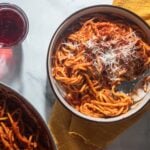
Homemade Spaghetti and Tomato Sauce Recipe
Chewy homemade spaghetti with a savory spiced tomato sauce. Sun-dried tomatoes and canned tomatoes make this a super tomato-forward dish.
Servings: 4 servings
Calories: 1024kcal
Equipment
- Hamilton Beach Electric Pasta Maker
Ingredients
For the homemade spaghetti:
- 350 grams all-purpose flour
- 50 grams semola rimacinata flour plus more for dusting
- 1 large egg
- 90 ml water
For the tomato sauce:
- 3 tablespoons extra-virgin olive oil
- 2 ½ ounces oil-packed sun-dried tomatoes drained and chopped
- ¾ teaspoon red pepper flakes
- 1 small onion finely chopped
- 28 ounces canned whole peeled tomatoes pureed, for a more homogeneous sauce, or hand-crushed for a more rustic sauce
- Salt and black pepper
- ½ teaspoon garlic powder
- 1 pound homemade spaghetti see recipe above
To serve:
- ½ cup freshly grated pecorino-romano cheese plus more if needed
- Extra-virgin olive oil for drizzling
Instructions
For the homemade spaghetti:
- Assemble all required parts for the pasta maker (refer to the instruction manual for more details). Affix the 'Thick Spaghetti' shaping disc to the extruder.
- Mix together 350 grams all-purpose flour and 50 grams semola rimacinata flour in a large bowl.
- Plug in the electric pasta maker. Tap 'Zero scale' to tare the scale. Slowly pour in the dry ingredients towards the back of the pasta maker's mixing bowl (this prevents any flour from getting stuck in the front extruder area). As you add the ingredients, the display screen will note the weight; you should have added 400 grams total.
- Beat 1 large egg until homogenous in the pasta maker's liquid measuring cup. Pour in 90 ml water and whisk until combined.
- Next, lock in the mixing bowl lid. Choose 'Pasta' to start the automatic pasta maker. You will see the liquid amount on the screen (note that unlike the dry scale, the listed amount will not change as you add liquid). Press 'Start/Stop' to start the pasta making process. You will hear the motor running and the mixing paddle will begin mixing. Slowly pour in the wet ingredients into the liquid well on the lid until fully combined. You may need to use a fork or small spatula to push any remaining bits through.
- At this point, the pasta maker will continue kneading the dough before allowing it to rest for a few minutes.
- Meanwhile, sprinkle a bit of semola or semolina flour on a large baking sheet or tray.
- Once the pasta maker finishes the waiting period, it will begin extruding the dough. For the first minute or so, the dough may extrude very slowly, and appear slightly dry. Eventually, it will begin to speed up and the dough will appear more moist. Allow the pasta to extrude until it reaches 12 inches, then use a knife or bench scraper to firmly cut it. Wrap the cut dough in a nest and place on the baking tray. Cover with a kitchen towel to prevent drying out. Repeat, allowing the pasta to extrude to 12 inches, then cutting it and wrapping it in a nest.
- Cook pasta immediately or store in an airtight container (make sure it's generously dusted with semolina to prevent sticking) in the fridge for up to 3 days.
For the tomato sauce:
- Heat 3 tablespoons extra-virgin olive oil in a large dutch oven or saute pan on medium heat.
- Add 2 ½ ounces oil-packed sun-dried tomatoes, drained and chopped, and saute for 2 - 3 minutes, or until tomatoes begin to brown and oil turns a light orange.
- Reduce the heat to medium-low and stir in ¾ teaspoon red pepper flakes. Saute for 30 seconds until aromatic.
- Add in 1 small onion, finely chopped, then cook, stirring frequently for 8 - 10 minutes until they are soft and translucent. A bit of browning is okay, but reduce the heat as necessary to prevent burning.
- Stir in 28 ounces canned whole peeled tomatoes and bring to a simmer. Add a pinch of salt (don't add too much here, because the sun-dried tomatoes are salty too), black pepper, and ½ teaspoon garlic powder. Simmer for 10 - 15 minutes, or until sauce thickens slightly. Taste and adjust for seasoning.
To serve:
- To cook the pasta, set a large pot of water to boil. Generously salt the water, then cook 1 pound homemade spaghetti for 4 - 6 minutes, or until it's floating and just barely al dente. Reserve 1 cup of pasta water.
- Transfer the spaghetti to the tomato sauce, and add a few tablespoons of pasta water, stirring to coat. Simmer spaghetti in sauce for a minute or two until the sauce clings to the pasta. Taste, and adjust for seasoning. Loosen the sauce if desired with more pasta water.
- Remove from the heat, then stir in ½ cup freshly grated pecorino-romano cheese until combined.
- Divide pasta amongst serving bowls. Grate with more cheese and drizzle a bit of olive oil on top. Enjoy!
Notes
Troubleshooting while extruding:
- If the pasta is sticking to itself, it's too wet and you will need to add 1 to 2 tablespoons of flour and re-knead the dough before extruding again.
- If the pasta is breaking apart very easily, it's too dry, so you should add about 10 ml of water and re-knead the dough before extruding again.
- If the dough appears to be the right consistency, but is very, very slowly extruding (and the pasta maker keeps starting and stopping), make sure the mixing bowl is fully aligned with the back of the machine and try again.
- Pecorino romano is necessary to cut the acidity of the tomato, so it's best not to substitute it with another cheese.
Nutrition
Calories: 1024kcal | Carbohydrates: 175g | Protein: 34g | Fat: 21g | Saturated Fat: 5g | Polyunsaturated Fat: 3g | Monounsaturated Fat: 11g | Trans Fat: 0.01g | Cholesterol: 60mg | Sodium: 516mg | Potassium: 1086mg | Fiber: 10g | Sugar: 9g | Vitamin A: 693IU | Vitamin C: 38mg | Calcium: 255mg | Iron: 9mg
